
When Light Became the Shutter
a short story of Harold Edgerton's most famous invention.

There are events happening around you that are simply too fast to see.
Yet, nearly a century ago, one man managed to freeze them in time.
That man was Harold Edgerton, an electrical engineer at MIT whose photographs revealed a hidden world of motion. His images of milk droplets suspended in midair, bullets piercing apples, and hummingbirds frozen in flight became some of the most iconic photographs ever taken.
“Bullet Through King”, 1964
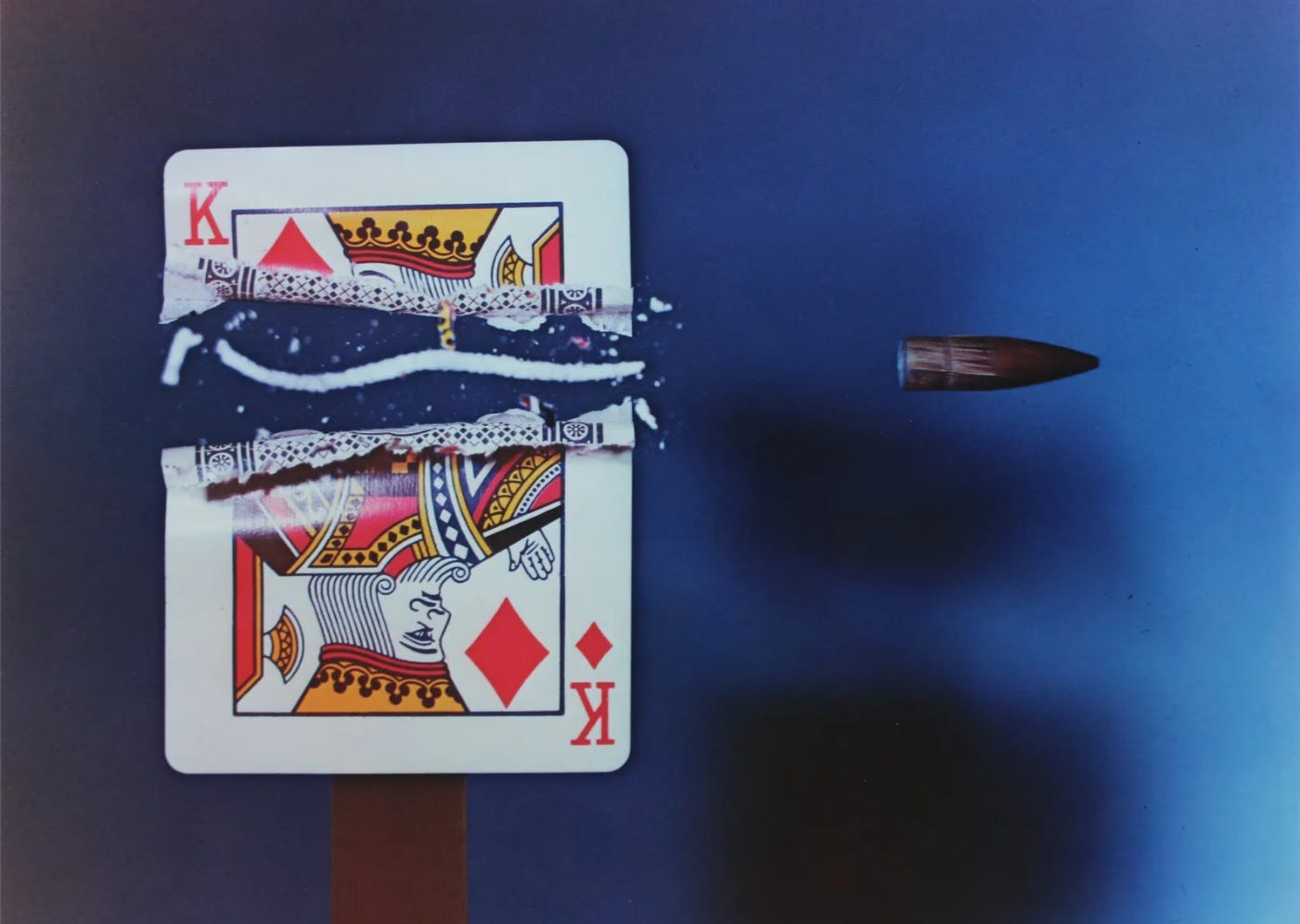
The bullet is not an illusion or a trick of editing. It is frozen in mid-air by a flash lasting only a few millionths of a second.
“Milk Drop Coronet”, 1957
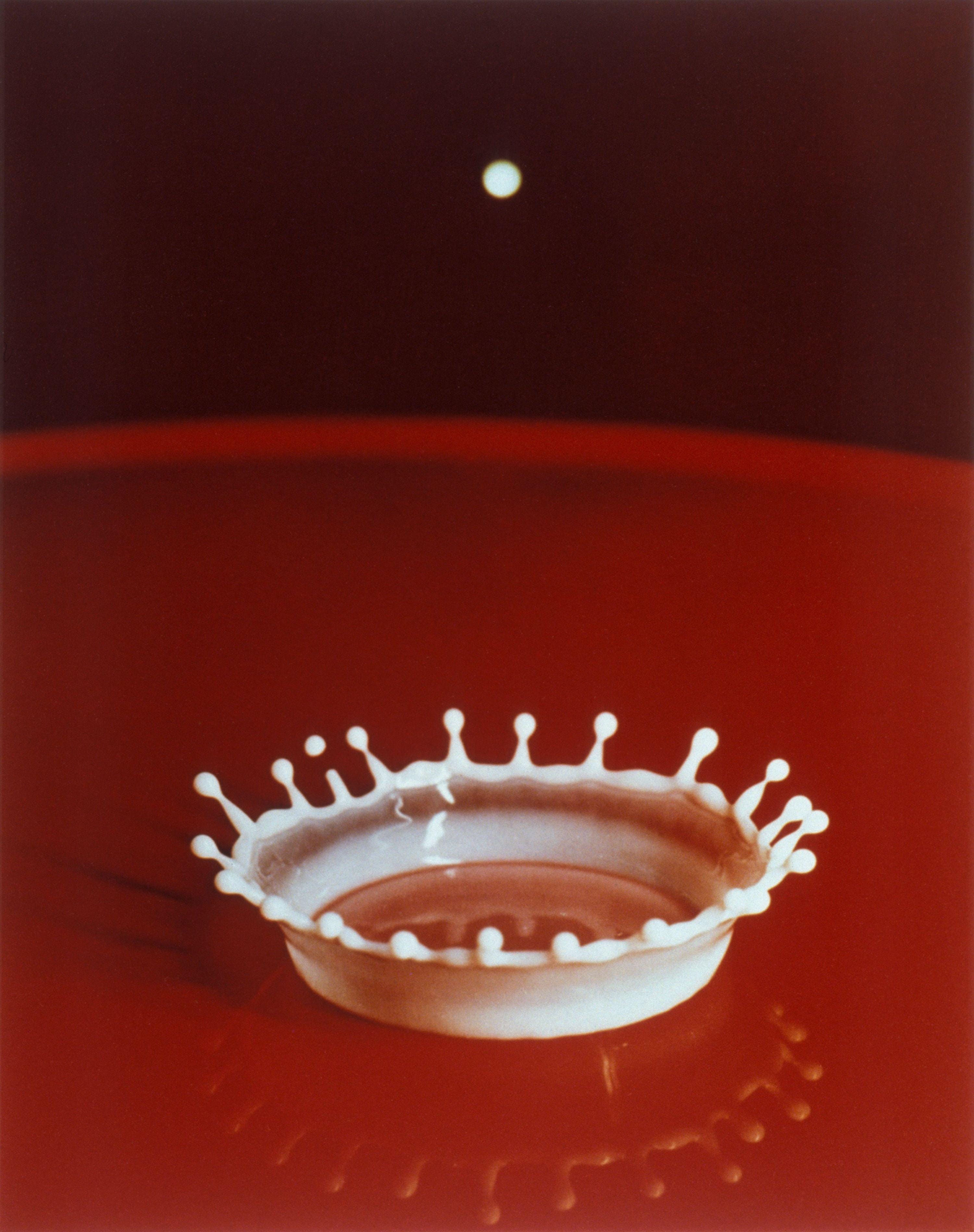
The crown-shaped splash existed for less than a millisecond. Before Edgerton, nobody had ever seen it clearly.
But before understanding how Edgerton captured these moments, we first need to understand why they are so difficult to photograph in the first place.
If you’ve ever used the slow-motion mode on your phone, you’ve already encountered the same problem Edgerton faced. Your phone may have an option for 120 or even 240 frames per second instead of the usual 30. Here, the camera takes 120 to 240 images per second. When these frames are played back at normal speed, time appears to slow down.
This raises a problem: each frame has less time to gather light. That’s why slow-motion videos often look darker and need much brighter lighting.
The exact same trade-off exists in photography. To freeze something moving incredibly quickly, a camera must expose its sensor (or film) to light for an incredibly short amount of time. The shorter the exposure, the sharper the image, but the less light reaches the camera.
A typical handheld photograph might use shutter speeds around 1/60 to 1/125 of a second. That’s more than fast enough to capture a stationary object or a person standing still. But once objects begin moving quickly, things become difficult.
To freeze these moments, photographers use much shorter shutter speeds: 1/10,000 of a second, 1/100,000 of a second, or even shorter. However, this creates a new problem. There is simply not enough time for light to reach the film or sensor. The image becomes dark and unusable.
By the early twentieth century, photographers had largely accepted this limitation. Some moments simply happened too quickly to capture.
Harold Edgerton refused to accept that.
At the time, flash photography relied on disposable flashbulbs filled with magnesium. If you’ve ever burned magnesium ribbon in a chemistry lab, you’ll remember the intense white light it produces. Flashbulbs worked on the same principle: an electric current ignited magnesium inside a glass bulb filled with oxygen, producing a brilliant flash bright enough to expose photographic film.
The system worked, but it had serious drawbacks. Each bulb could only be used once, and more importantly for Edgerton, the flash itself was not short enough to freeze extremely rapid motion.
Instead of trying to make the camera shutter impossibly fast, he asked a much simpler question:
What if the shutter stayed open, and the light itself lasted only a millionth of a second?
His answer was his most famous invention: The electronic strobe.
Inside the strobe was a sealed glass tube filled with gas. Early prototypes used mercury vapour, while later designs switched to gases such as neon and, most commonly, xenon. At either end of the tube sat electrodes connected to a capacitor (a device capable of storing electrical energy in an electric field) .
The capacitor was slowly charged to several thousand volts. Under normal conditions, the gas inside the tube behaves as an insulator and does not allow current to flow. To overcome this, a separate triggering circuit produced a brief high-voltage pulse that ionised the gas, stripping electrons from some of its atoms and creating a plasma. (a state of matter consisting of free electrons and positively charged ions).
Once the gas became conductive, the capacitor discharged almost instantaneously through the tube. The enormous current accelerated electrons through the plasma, causing countless collisions with atoms and ions. These collisions excited the atoms to higher energy states. As they relaxed back to their original states, they released the excess energy as photons, producing an extraordinarily intense flash of light.
The brilliance of the flash was only half of the story. Because the capacitor discharged so quickly, the burst of light lasted for only a few microseconds; and in some of Edgerton’s experiments, even less than a single microsecond.
To appreciate how short this is, consider a bullet travelling at 800 metres per second. In one microsecond, it moves less than a millimetre. For all practical purposes, the bullet appears frozen in space.
Rather than making the camera shutter faster, he made the light itself shorter, and this was Edgerton’s breakthrough.
In a dark room, the camera’s shutter could remain open for seconds at a time; the true exposure was determined entirely by the fleeting burst of light from the strobe.
This breakthrough led to some of the most fantastic high speed photos ever taken. ( I have to bring up this bullet through card photograph because I find that to be the coolest photo ever ).
Here’s a quick ‘show and tell’ of some of his photographs:
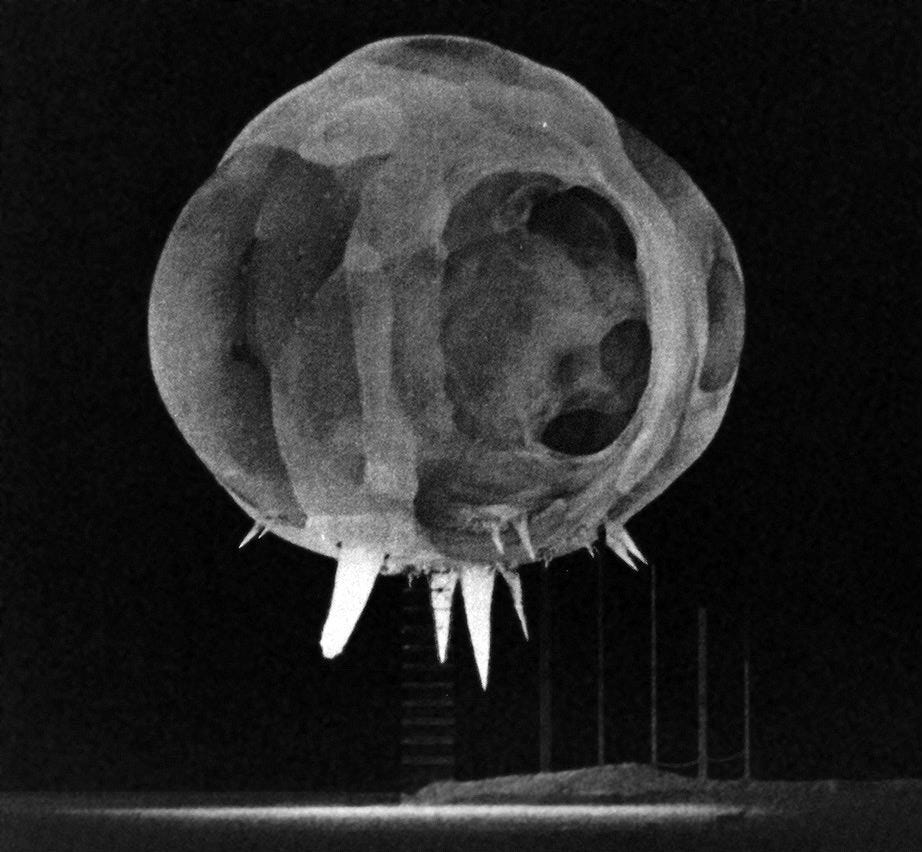
Nuclear explosion from the Tumbler-Snapper test series in Nevada, circa 1952, photographed by a rapatronic camera less than 1 millisecond after detonation. In this shot, the fireball is about 20 m (66 ft). The spikes at the bottom of the fireball are known as the rope trick effect.
- atomicphotographs.com
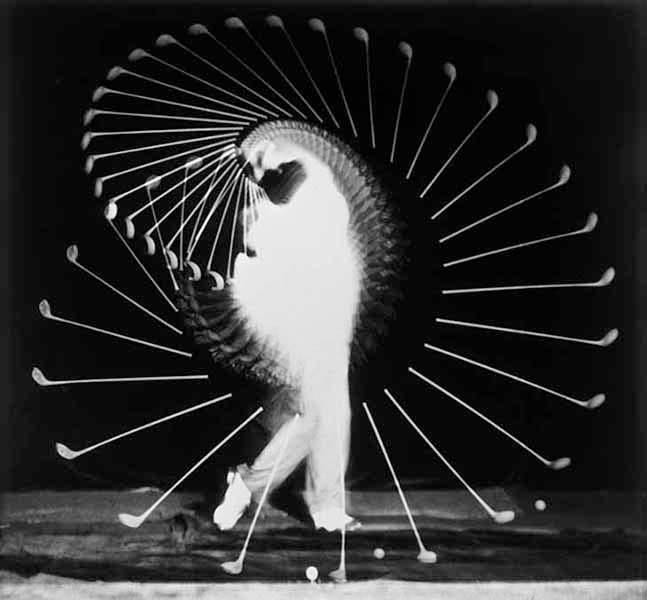
A golfer’s swing, images recorded every 1/100th of a second, in Harold Edgerton, Flash!, 1939
BIBLIOGRAPHY
https://www.bbc.com/future/article/20140722-the-man-who-froze-the-world
https://atomicphotographers.com/photographers/harold-edgerton/ - Cool photographs
https://infinite.mit.edu/video/harold-doc-edgerton-electronic-flash-lamp%E2%80%9D-dept-electrical-engineering-lecture-4231973/ - highly suggest watching if curious for deepet insite